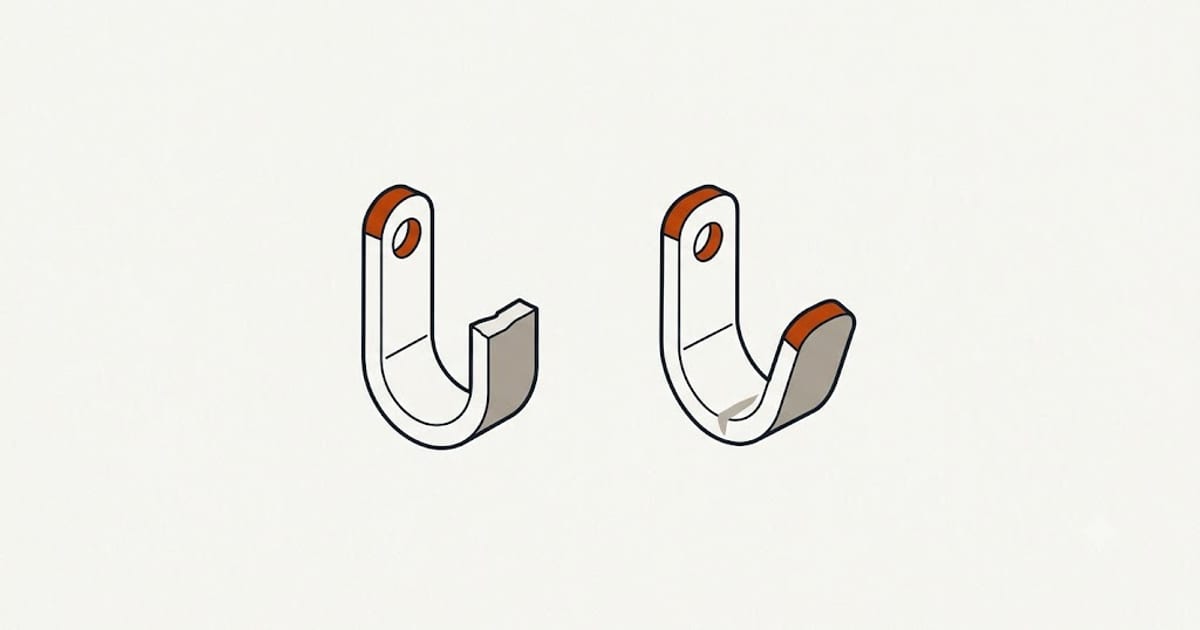
"PLA+" is a marketing name, not a standard. Every manufacturer means something slightly different by it, and there is no specification behind the plus sign.
What they have in common is a base PLA modified with additives to reduce brittleness. The result is a genuinely different material that happens to share part of a name.
The printing difference
The clearest evidence is in the published data sheets. eSUN publishes 210–230 °C for PLA+, against 190–230 °C for standard PLA from Polymaker and Bambu.
The bottom of the range moves up by 20 °C. The toughening additives that reduce brittleness also make the melt stiffer, so it needs more heat to flow properly.
Running PLA+ at plain-PLA temperatures is one of the most common causes of weak layer bonding, and the failure looks like a bad spool rather than a settings mismatch. The part prints, looks correct, and separates along a layer when flexed.
Full brand-by-brand figures are in PLA print temperature.
What you gain and lose
Gain: toughness. PLA+ bends and absorbs impact where standard PLA cracks. For a bracket, a hook, a clip, anything that gets knocked or flexed, this is the difference between a part that survives and one that does not.
Lose: stiffness. Standard PLA is stiffer. For a jig, a fixture, a straight edge, something that must hold its shape under load, plain PLA is the better material and the "upgrade" is a downgrade.
Unchanged: heat resistance. This is the important one. PLA+ softens at essentially the same temperature as PLA — around 60 °C. If your part failed because it sat in a hot car, PLA+ will fail too. That problem needs PETG or ABS.
Usually: surface finish and layer adhesion improve slightly, once printed at the correct temperature.
Is it worth the premium
PLA+ typically costs a little more per kilogram. On a 40 g print that is pennies, so price should not decide it.
Use PLA+ for functional parts that get handled, dropped or flexed. Use standard PLA for models, prototypes, display pieces and anything that must stay rigid. Use neither if heat is the problem.
Other names for the same idea
"Tough PLA", "PLA Pro", "High-Speed PLA" and similar are the same category — modified PLA blends with no shared standard between brands.
Which means the only reliable guide is the manufacturer's own data sheet. Two spools both labelled PLA+ from different brands can want different temperatures and behave differently, and neither is wrong.
Read the sheet, print a temperature tower for the actual spool, and treat the label as a hint rather than a specification. The method is in printing a temperature tower.
How to tell which you have
The spool label is the only reliable source, and it is not always on the spool once the packaging is gone. Two practical checks if you have lost track:
Snap a short offcut. Standard PLA breaks cleanly with a sharp crack and a flat fracture face. A toughened blend bends first, whitens at the bend, and resists before it goes. This is a crude test and it is usually decisive.
Print at 200 °C and flex the part. If layers separate easily, you are probably running a toughened blend too cool.
Neither test tells you the correct temperature — only the data sheet does. But either will tell you whether to expect PLA behaviour or not, which is enough to know that a 20 °C jump might be the fix.
Where the toughness actually shows
Not in a strength test. Pull both to destruction and standard PLA usually holds a higher figure, which is why data sheets can make PLA+ look like a downgrade.
The difference appears in repeated small loads: a clip opened and closed a hundred times, a bracket knocked in a drawer, a printed hinge. Standard PLA accumulates micro-cracks and fails suddenly; the toughened blend deforms and keeps working.
If a part failed by snapping rather than by deforming, PLA+ is the right response. If it failed by sagging, the material was never the issue — heat was.
FAQ
What is the difference between PLA and PLA+?
PLA+ is a toughened blend with additives that reduce brittleness. It needs a higher printing temperature and bends rather than cracking.
Does PLA+ print at the same temperature as PLA?
No. eSUN publishes 210–230 °C for PLA+ against 190–230 °C for standard PLA. Printing it too cool causes weak layer bonding.
Is PLA+ more heat resistant?
No. It softens at around the same temperature as PLA, roughly 60 °C. For heat resistance you need PETG or ABS.
Is PLA+ stronger than PLA?
Tougher, not stiffer. It absorbs impact better; standard PLA resists bending better.
Is PLA+ a standard?
No. It is a marketing name and each manufacturer's version differs. Use their data sheet rather than the label.