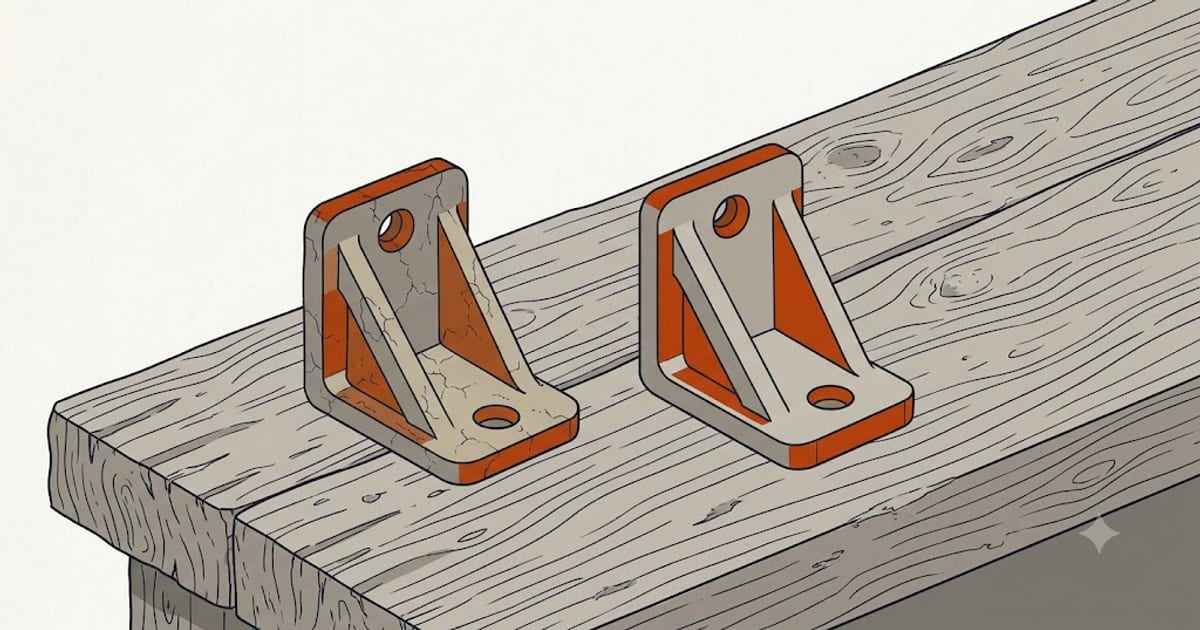
ASA was developed as a UV-stable alternative to ABS, and mechanically the two are close enough that most comparisons come down to one property.
| ABS | ASA | |
|---|---|---|
| Glass transition | ~105 °C | ~100 °C |
| UV stability | poor — yellows, embrittles | good |
| Warping | severe | severe |
| Enclosure | required in practice | required in practice |
| Fumes | styrene | styrene |
| Acetone smoothing | yes | partially |
| Cost | lower | slightly higher |
The one that decides it
ABS degrades in sunlight. Over months of outdoor exposure it yellows, the surface chalks, and it becomes brittle enough to snap where it used to flex.
ASA holds its colour and mechanical properties far longer. That is the entire reason it exists, and it is why automotive exterior trim has used ASA for decades.
Anything living outdoors should be ASA. Anything indoors can be either, and ABS is cheaper.
Everything else is much the same
Warping. Both contract significantly as they cool and both need an enclosure for anything but small parts. Some printers report ASA warping slightly more; in practice the mitigations are identical — enclosure, hot bed around 100–110 °C, no draughts, minimal part cooling.
Fumes. Both emit styrene and both need ventilation. Neither belongs in an unventilated bedroom.
Strength. Comparable. Neither is dramatically tougher than the other, and both are tougher but less stiff than PLA — the comparison is in PLA vs ABS.
Acetone smoothing. ABS's party trick: acetone vapour dissolves the surface into a glossy finish. ASA responds less predictably, so if vapour smoothing is the point, ABS keeps that advantage.
Printing either
- Nozzle typically 240–260 °C.
- Bed 100–110 °C.
- Part cooling fan off or very low.
- Enclosure, and keep the door shut — opening it mid-print is a common cause of a corner lifting.
- Brim or raft for plate contact.
- Ventilation for the room, not just the enclosure.
The enclosure requirement is the practical barrier. On an open printer both materials are frustrating, and there is a better answer for most parts.
Consider PETG first
Most reasons people reach for ABS or ASA are covered by PETG: about 80 °C service temperature, tough, weather-resistant enough for many outdoor uses, and it needs no enclosure and produces no styrene.
ABS and ASA earn their difficulty when you genuinely need 90 °C and above, or acetone smoothing, or long-term UV exposure in a structural part.
For a garden hook or an outdoor bracket, PETG is usually the sensible answer and the easier print.
What UV degradation actually looks like
It is gradual and it is easy to miss until the part fails.
First few weeks — barely visible. Colour may shift very slightly.
Two to six months — yellowing on light colours, a chalky surface texture, and loss of gloss. Black parts hide this and degrade anyway.
Six months and beyond — fine surface cracking, and the part snaps where it previously flexed. A bracket that was fine all summer breaks the first time it is knocked in autumn.
The mechanism is UV breaking polymer chains at the surface, so the damage is worst on the exposed face and the part fails from the outside in. Painting an ABS part is genuinely protective for this reason, and is a legitimate way to use up ABS outdoors if you already have it.
Cost, honestly
ASA usually costs a little more per kilogram. On a part large enough for the choice to matter, the difference is a few dollars.
Replacing a failed outdoor ABS part — including the print time, the enclosure occupancy and the trip up a ladder — costs more than that every time. Where the part lives outdoors, ASA is the cheaper material on any horizon longer than one summer, and the price comparison is misleading.
Where the part lives indoors, ABS's lower price is real and the UV advantage buys nothing.
FAQ
Is ASA better than ABS?
For outdoor use, clearly — it resists UV where ABS yellows and embrittles. Indoors they are close and ABS is cheaper.
Does ASA warp less than ABS?
Not meaningfully. Both need an enclosure and the same mitigations.
Can ASA be smoothed with acetone?
Less predictably than ABS. If vapour smoothing is the goal, ABS remains better at it.
Do I need an enclosure for ASA?
For anything but small parts, yes. Both materials contract enough while cooling to lift their own corners.
Should I use ASA or PETG outdoors?
PETG for most hobby parts — easier, no fumes, no enclosure. ASA when you need higher temperature resistance or long-term structural UV exposure.