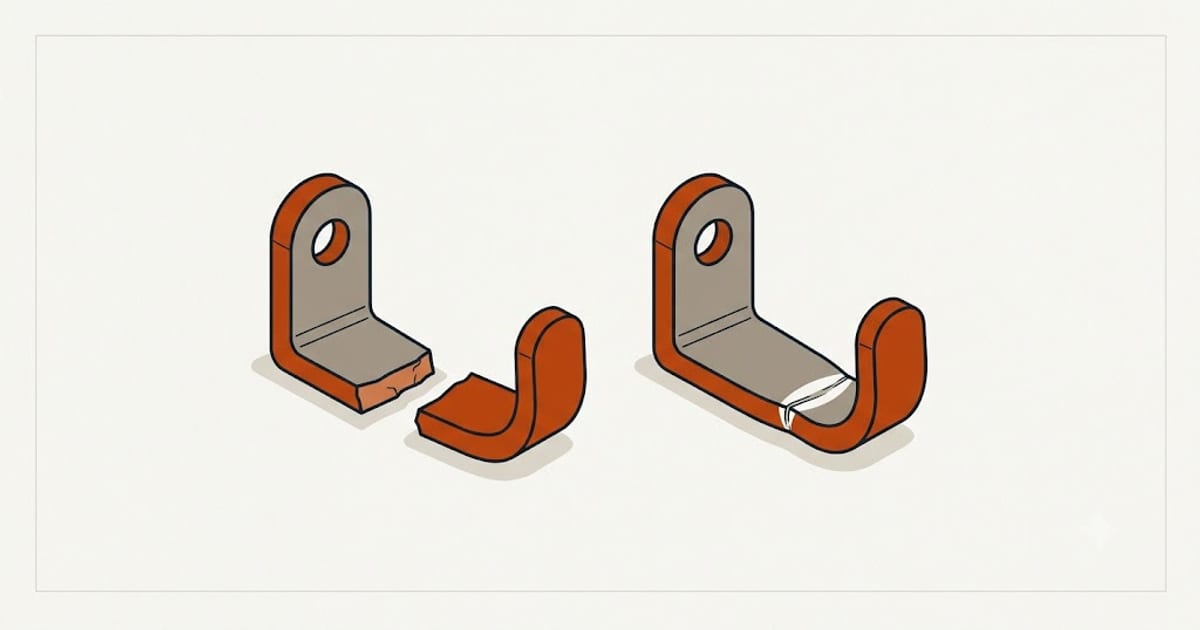
The comparison people expect is a strength contest, and by the usual number PLA wins it: PLA typically tests around 50–60 MPa tensile strength, PETG around 45–50.
Then they print a bracket in PLA and it snaps, print the same bracket in PETG and it survives, and conclude the numbers are wrong.
The numbers are fine. Tensile strength is simply not the property that was being tested.
Stiffness and toughness are different things
Stiffness is how much force it takes to bend something. Toughness is how much energy it absorbs before it breaks.
PLA is stiffer and more brittle: it resists deflection well and then fails suddenly, with a flat, clean fracture. PETG is less stiff and far tougher: it bends, whitens, and keeps going.
Almost every part that fails in real use fails from an impact, a drop or repeated flexing — not from being pulled steadily until it parts. Those are toughness problems, which is why the material with the lower tensile number is the one that survives.
Where PLA genuinely wins is anything that must not deflect: a jig, a fixture, a straight edge, a printer part holding alignment. There PLA's stiffness is the point.
Heat is not close
| PLA | PETG | |
|---|---|---|
| Glass transition | ~60 °C | ~80 °C |
| Realistic service temperature | ~50 °C | ~70 °C |
| Car interior in summer | fails | usually survives |
This is the clearest separation between the two. A PLA part left on a dashboard in summer will sag — this is the single most common way people discover PLA's temperature limit, and the failure is dramatic rather than subtle.
Anything that will sit in a car, near a window in direct sun, in an enclosure with electronics, or anywhere near a heat source should not be PLA.
Printability is where PLA wins back ground
PLA is the easiest common filament to print, and PETG is not difficult so much as different. The specific differences:
- Cooling. PLA wants full fan; PETG wants 30–50% or layer adhesion suffers.
- Bed release. PLA needs adhesion help; PETG bonds so well to smooth PEI it can pull chips off the sheet.
- Stringing. PETG strings more, and stays stringy until the filament is dry.
- Overhangs and bridges. PLA is better, directly because it can take more cooling.
Full details are in PETG print settings and PLA print temperature.
Choosing without agonizing
Use PLA when the part is decorative, dimensionally fussy, needs to stay rigid, has difficult overhangs, or will live indoors at room temperature. Prototypes, models, jigs, printer upgrades.
Use PETG when the part will be dropped, flexed, clamped, left in a car, exposed to weather, used outdoors, or holds anything you would be annoyed to lose. Brackets, enclosures, hooks, functional hardware.
Use neither when you need above 70 °C or genuine UV stability outdoors — that is ABS/ASA territory, and it comes with an enclosure and its own set of problems.
Cost is not a factor
PETG typically runs a dollar or two more per kilogram than PLA. On a 40-gram print that is a difference of a few cents, and it should never decide the material.
The costs that matter are covered in what a 3D print actually costs, and material price is not near the top of the list.
FAQ
Is PETG stronger than PLA?
Not in tensile strength — PLA usually tests higher. PETG is tougher, meaning it absorbs impact and flexing rather than cracking. For most parts that fail in real use, toughness is what mattered.
Can PLA be used outside?
Poorly. It softens around 60 °C, which direct sun on a dark part can reach, and it degrades under UV. PETG holds up better; ASA is the material actually designed for it.
Is PETG harder to print than PLA?
Different rather than harder. The three settings to change are fan (lower), bed release (PETG sticks too well to smooth PEI), and drying (PETG absorbs moisture quickly).
Which is better for a phone case?
PETG, comfortably. A case exists to absorb impact and may sit in a hot car, and both of those are PLA's weaknesses.
Does PETG smell when printing?
Much less than ABS. Both PLA and PETG are considered low-odor, though any printing benefits from ventilation.