| PETG | ABS | |
|---|---|---|
| Glass transition | ~80 °C | ~105 °C |
| Realistic service temp | ~70 °C | ~90 °C |
| Warping | mild | severe |
| Enclosure | not needed | required in practice |
| Fumes | low odour | styrene, needs ventilation |
| Toughness | good | good |
| UV outdoors | moderate | poor |
The two are closer than PLA is to either. What separates them is the last 20 °C, and how much difficulty you accept to get it.
The 20 degrees that matter
PETG softens around 80 °C, ABS around 105.
Between those figures sits a narrow band of real applications: parts in an enclosure with power electronics, parts near a motor or a heated bed, parts on a dashboard in a hot climate. For those, ABS or ASA is the answer and PETG will sag.
Below that band — which is nearly everything, including a car interior in most conditions — PETG does the same job.
What PETG saves you
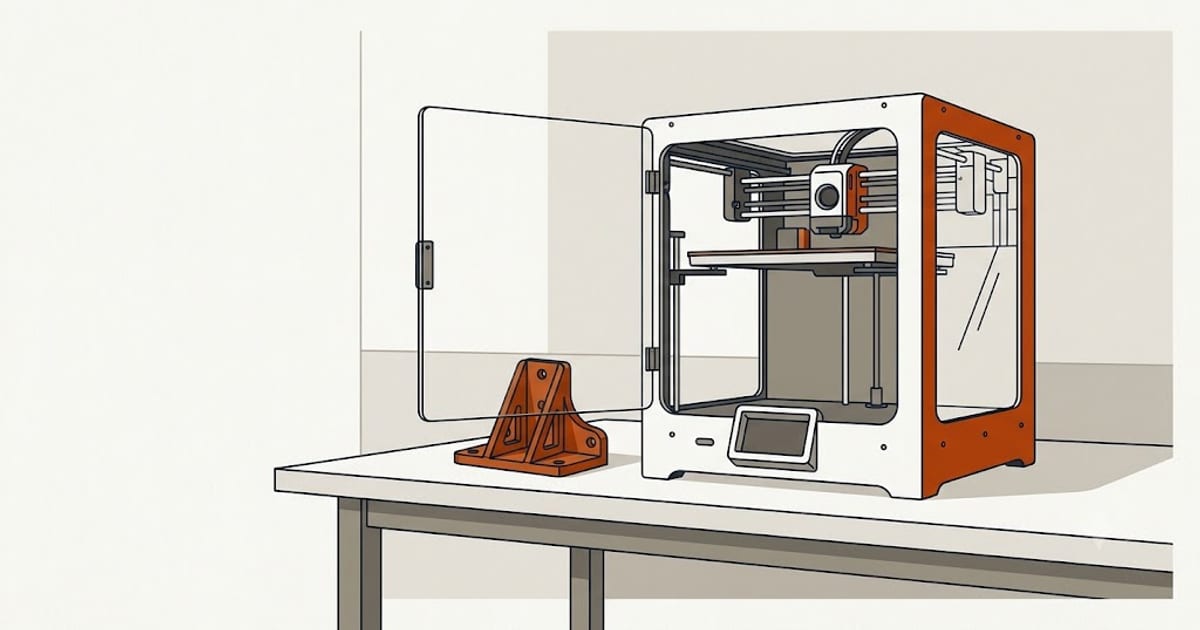
No enclosure. ABS contracts sharply as it cools and lifts its own corners on an open printer. Large flat ABS parts on an open machine are a losing fight; PETG warps mildly and prints fine in a normal room.
No styrene. ABS emits it and needs ventilation. Neither belongs in an unventilated bedroom, but only one of them is the reason.
Fewer settings to get wrong. PETG needs three changes from PLA — lower fan, bed release, drying — and they are documented in PETG print settings. ABS needs those plus enclosure temperature management.
What ABS gives back
Acetone vapour smoothing. Dissolves the surface into a glossy finish. PETG has no equivalent, and for display pieces this is a genuine advantage.
Machinability. ABS drills, taps and sands more predictably. PETG is tougher and tends to gum up abrasives and drag on a drill bit.
Cost. Usually slightly cheaper.
Higher temperature, as above.
Neither for outdoors
PETG holds up moderately in sun. ABS yellows and embrittles within months.
For anything living outdoors, ASA is the material actually designed for it — see ABS vs ASA. It prints like ABS, including the enclosure requirement.
Choosing
PETG — brackets, enclosures, hooks, functional hardware, anything dropped or flexed, anything mildly warm. The default for functional parts.
ABS — parts above about 70 °C, or parts you intend to vapour smooth.
ASA — outdoors.
PLA — anything that must stay rigid and lives at room temperature. The stiffness comparison is in PLA vs PETG.
Toughness is closer than the table suggests
Both are ductile — they bend and absorb impact rather than cracking, which is what separates either from PLA. Between the two, the difference is in how they fail rather than how much they take.
PETG stretches noticeably before it gives, often whitening at the stress point first. That whitening is a useful warning: a PETG part frequently tells you it is overloaded before it breaks.
ABS is stiffer and gives less warning, but it holds up better to repeated flexing over long periods — living hinges and clips that cycle thousands of times last longer in ABS.
For a bracket that takes one hard knock, PETG. For a part that flexes every day for years, ABS has the edge.
Layer adhesion differs in an important way
ABS bonds between layers exceptionally well, particularly in an enclosure where the whole part stays warm. A well-printed ABS part is close to isotropic — it is nearly as strong across layers as along them.
PETG is good but not that good, and a PETG part loaded across the layer lines is its weakest orientation. This is worth remembering when orienting a functional part on the plate: put the layer lines perpendicular to the main load if you can.
It is also why cooling settings matter so much in PETG, and why running PLA's fan setting produces parts that snap along a layer — the mechanism is set out in PETG print settings.
FAQ
Is PETG or ABS better?
PETG for most functional parts — similar toughness without an enclosure or styrene fumes. ABS when you need service temperatures above about 70 °C, or acetone smoothing.
Can PETG replace ABS?
For most applications, yes. The exception is the band between roughly 80 and 100 °C, where only ABS or ASA holds up.
Does PETG need an enclosure?
No. It warps mildly and prints reliably on an open machine.
Can PETG be smoothed with acetone?
No. Acetone smoothing is an ABS property, and it is one of the few remaining reasons to choose ABS for display pieces.
Which is better outdoors?
Neither, really. PETG holds up moderately; ABS degrades quickly in UV. ASA is the material designed for outdoor use.