| PLA | ABS | |
|---|---|---|
| Glass transition | ~60 °C | ~105 °C |
| Realistic service temp | ~50 °C | ~90 °C |
| Warping | minimal | severe |
| Enclosure | not needed | effectively required |
| Fumes | low odour | styrene, needs ventilation |
| Tensile strength | 50–60 MPa | ~40 MPa |
| Impact resistance | poor | good |
| Post-processing | sanding | acetone vapour smoothing |
Note the strength rows. PLA tests higher in tensile strength than ABS and is stiffer. What ABS has is toughness — it absorbs impact rather than cracking, and it survives heat.
Heat is the real reason to use ABS
PLA's glass transition is around 60 °C, which a dark part in a parked car reaches easily. It does not melt dramatically; it sags, and a sagged part is finished.
ABS at ~105 °C survives that comfortably, along with enclosures containing electronics, parts near motors, and anything in direct summer sun.
If your part will never exceed about 50 °C, this advantage buys you nothing and everything below is pure cost.
Warping is the price
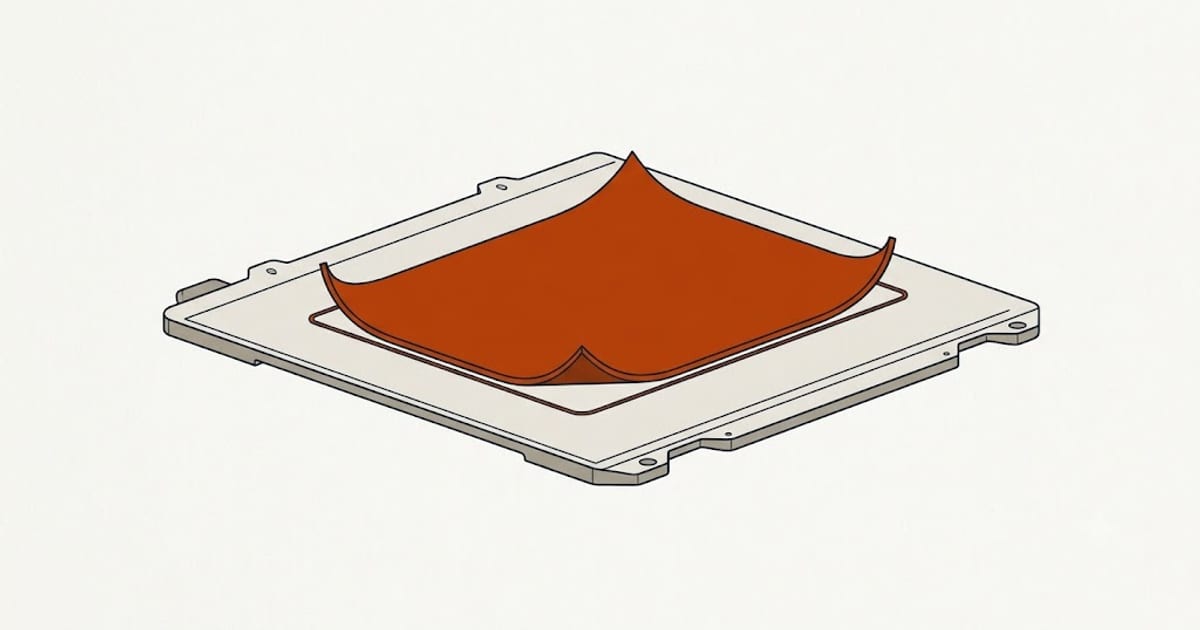
ABS contracts significantly as it cools. When the lower layers have cooled and contracted while the upper ones are still hot, the part pulls its own corners off the plate.
Managing it means:
- An enclosure. Keeps ambient temperature high and stable so the whole part cools together. This is the big one, and it is why ABS is genuinely hard on an open printer.
- No draughts. A door opening across the room can lift a corner.
- Hot bed, typically 100–110 °C.
- Brims or rafts to add plate contact.
- No part cooling fan, or very little — the opposite of PLA.
Large flat ABS parts on an open printer are a losing fight. Small parts are manageable.
Fumes
ABS emits styrene while printing. It has a distinct smell and is not something to breathe in an unventilated room, particularly a bedroom or a shared office.
Ventilation, an enclosure with filtration, or a separate space. PLA has no equivalent concern and this alone rules ABS out for many people.
ASA has largely replaced it outdoors
ASA prints almost identically to ABS — same enclosure, same warping behaviour, same temperatures — with one difference: it is UV stable.
ABS yellows and becomes brittle in sunlight over months. ASA does not. For anything living outdoors, ASA is the better material at similar cost, and ABS's remaining advantage is mostly price and acetone smoothing.
Choosing
PLA — prototypes, models, indoor parts, anything dimensionally fussy, anything with difficult overhangs. The default, and correctly so.
ABS — parts that get hot, need impact resistance, or will be acetone-smoothed. Requires an enclosure and ventilation.
ASA — anything outdoors.
PETG — the middle ground most people actually want: ~80 °C glass transition, tough, no enclosure, no fumes. It covers most of the reasons people reach for ABS without the difficulty. See PLA vs PETG.
FAQ
Is ABS stronger than PLA?
Not in tensile strength — PLA tests higher. ABS is tougher, absorbing impact rather than cracking, and far more heat resistant.
Can I print ABS without an enclosure?
Small parts sometimes. Large flat parts will warp and lift. An enclosure is effectively required for reliable results.
Is ABS dangerous to print indoors?
It emits styrene and needs ventilation. Do not print it in an unventilated bedroom or shared room.
Should I use ABS or PETG?
PETG for most cases — it covers heat resistance up to about 70 °C and toughness without an enclosure or fumes. ABS only if you need higher temperatures or acetone smoothing.
What is ASA and how does it differ from ABS?
ASA prints almost identically but is UV stable. For outdoor parts it is the better choice.