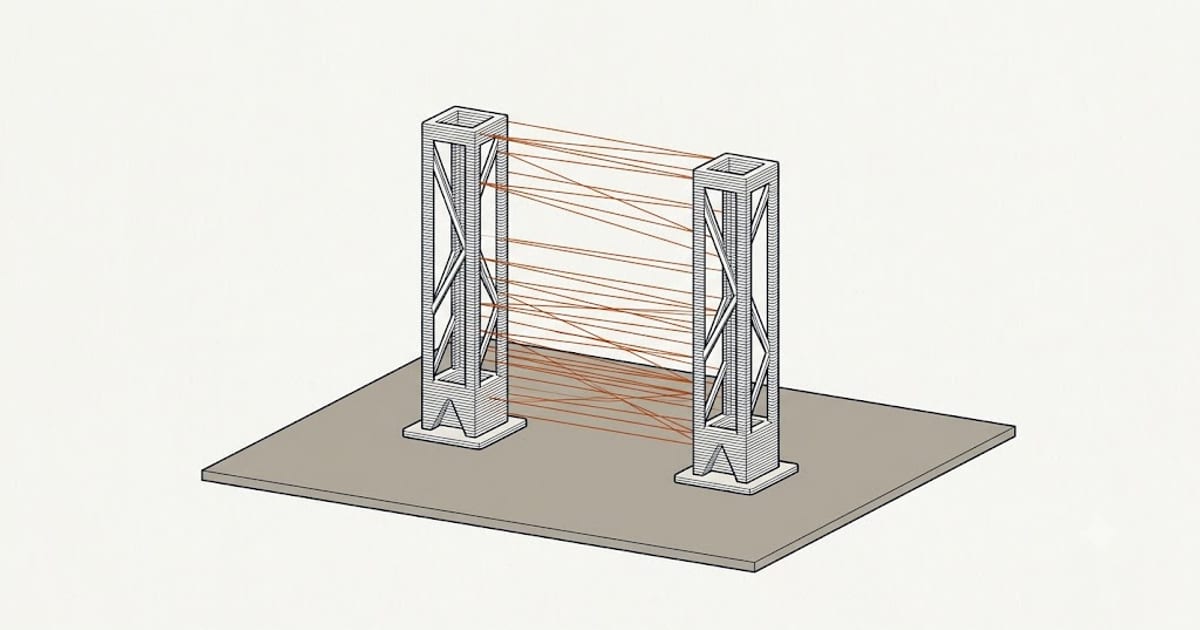
Stringing is molten plastic escaping from the nozzle during a move where nothing should be extruded. Every fix works by making less plastic available to escape, or by giving it less time to do so.
There are four causes. They need different fixes, and the order in which most people try them is almost exactly backwards.
Diagnose first
| Symptom | Cause |
|---|---|
| Popping or crackling from the nozzle; rough, pitted surfaces; stringing at every temperature you try | Moisture |
| Strands are thick and stringy; surfaces glossy; overhangs sag | Nozzle too hot |
| Strands are fine and hair-like; surfaces otherwise good; worse on prints with many separate parts | Retraction |
| Only on long travel moves across open space; short moves are clean | Travel speed |
The key discriminator is the third column of that first row: stringing that does not change when you change temperature is not a temperature problem. If you have run a temperature tower and every block strings, stop adjusting heat and dry the filament.
1. Moisture — the one people skip
PLA absorbs water from the air. That water flashes to steam inside the melt zone, blowing tiny holes in the extrusion and pushing plastic out of the nozzle when nothing is calling for it.
It is the most common cause of stringing and the least often suspected, because a wet spool looks identical to a dry one.
Two of the four major brands publish a drying schedule:
| Filament | Drying | Storage |
|---|---|---|
| Polymaker PolyLite PLA | 55 °C for 6 h | — |
| Bambu PLA Basic | 55 °C for 8 h | < 20 % RH, sealed with desiccant |
| eSUN PLA+ | 50 °C for 8–12 h | — |
| Prusament PLA | not specified | — |
Note the ceiling. All published schedules sit at or below 55 °C, because PLA softens around 55–60 °C and a dryer above that will fuse the coil into a solid block that no longer unwinds. Do not improvise upward.
A spool that has sat unsealed for a few weeks in a humid room will string no matter what you do to retraction. Dry it first, then continue down this list.
2. Nozzle temperature
Hotter plastic is less viscous and escapes more easily. If your temperature tower showed clean blocks at the bottom and strings at the top, you are simply running too hot — come down 5 °C at a time.
Do this before touching retraction, because retraction settings tuned at the wrong temperature have to be re-tuned once you fix the temperature. See PLA print temperature and how to print a temperature tower.
The trap: dropping temperature reduces stringing and reduces layer bonding. If you find yourself lowering it past the bottom of your filament's published range to control strings, the strings are not coming from heat.
3. Retraction
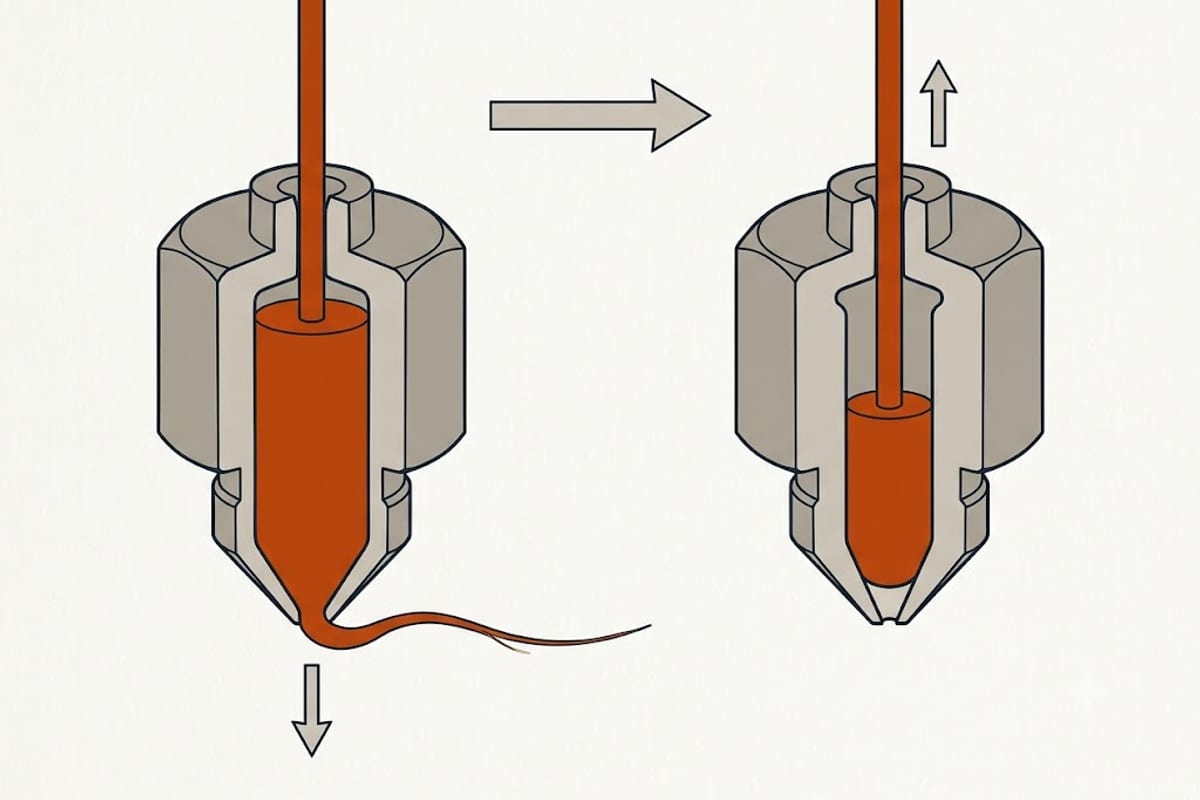
Retraction pulls filament backwards so the pressure at the nozzle tip drops below the point where plastic can escape.
Published starting figures differ by extruder type, which is the single biggest variable:
| Filament | Retraction distance | Retraction speed |
|---|---|---|
| Polymaker PolyLite PLA | 1–3 mm | 20–40 mm/s |
| Bambu PLA Basic | 0.6–1.0 mm | 20–40 mm/s |
Bambu's much shorter distance is a direct-drive figure: the extruder gear sits centimetres from the melt zone, so a small movement changes pressure immediately. A Bowden setup pushes filament down a long PTFE tube that stretches and compresses under pressure, so it needs several times the distance to achieve the same pressure drop — which is where Polymaker's wider 1–3 mm range comes from.
Use the figure that matches your extruder, not the one that matches your filament brand.
More is not better. Excessive retraction pulls molten plastic back up into the cold zone of the heat break, where it solidifies into a plug. The symptom is under-extrusion or a clog a few minutes later, and it is a far more annoying problem than stringing.
4. Travel speed and travel avoidance
Faster travel gives escaping plastic less time to form a strand. Raising travel speed to 150–200 mm/s clears up mild stringing on its own.
Two related settings worth enabling before adding more retraction:
- Avoid crossing walls / combing — routes travel moves through the inside of the part where any oozing is invisible.
- Retract only when crossing open space — stops the extruder retracting hundreds of times per layer on infill, which wears the filament and creates its own problems.
The tuning sequence
- Dry the filament if there is any doubt at all.
- Find your temperature with a tower, and use the lowest temperature that still gives good layer bonding.
- Set retraction to your extruder's published starting figure — around 0.8 mm direct, around 2 mm Bowden.
- Print a two-tower test: two thin towers 30 mm apart, forcing a travel move between them on every layer.
- Adjust retraction distance in 0.2 mm steps, one variable at a time, until the gap is clean.
- Only then raise travel speed if any strands remain.
A little wisping between towers that brushes off with a fingernail is normal and not worth chasing. Chasing the last trace of it is how people end up with retraction settings that clog the hot end.
FAQ
Why is my PLA stringing all of a sudden?
The most likely change is moisture — a spool that has been sitting out of a sealed bag for a few weeks strings even though nothing about your settings changed. Dry it at 50–55 °C for 6–8 hours and retest before adjusting anything.
What retraction distance should I use for PLA?
It depends on your extruder, not your filament. Bambu publishes 0.6–1.0 mm for a direct-drive setup; Polymaker publishes 1–3 mm, which covers Bowden. Both publish 20–40 mm/s for retraction speed.
Does lowering the temperature fix stringing?
Sometimes, and only if temperature is the cause. If your filament is wet, the stringing continues at every temperature in the published range, and lowering further just costs you layer strength.
Can I dry PLA in a kitchen oven?
Only if you can hold it at or below 55 °C, which most domestic ovens cannot do reliably at the bottom of their range. PLA softens around 55–60 °C and an overheated spool fuses into a block that will not unwind.
Is a little stringing acceptable?
Yes. Fine wisps that brush off with a fingernail are normal on prints with many travel moves. Pushing retraction higher to eliminate them risks pulling molten plastic into the cold zone of the heat break and clogging the nozzle.