Wet filament does not announce itself as a moisture problem. It announces itself as stringing, weak layers, a rough surface and inconsistent extrusion — all of which look exactly like a settings problem, which is why people lose days to it.
There is one symptom that is unambiguous, and it is audible.
The tell is a popping sound
Listen at the nozzle. Water absorbed into the filament turns to steam in the melt zone and escapes through the molten plastic, and you can hear it: a faint crackle or pop, like a distant snap of static. On badly saturated filament you can see wisps of steam at the tip.
Nothing else in a working printer makes that noise. If you hear it, stop tuning and dry the spool.
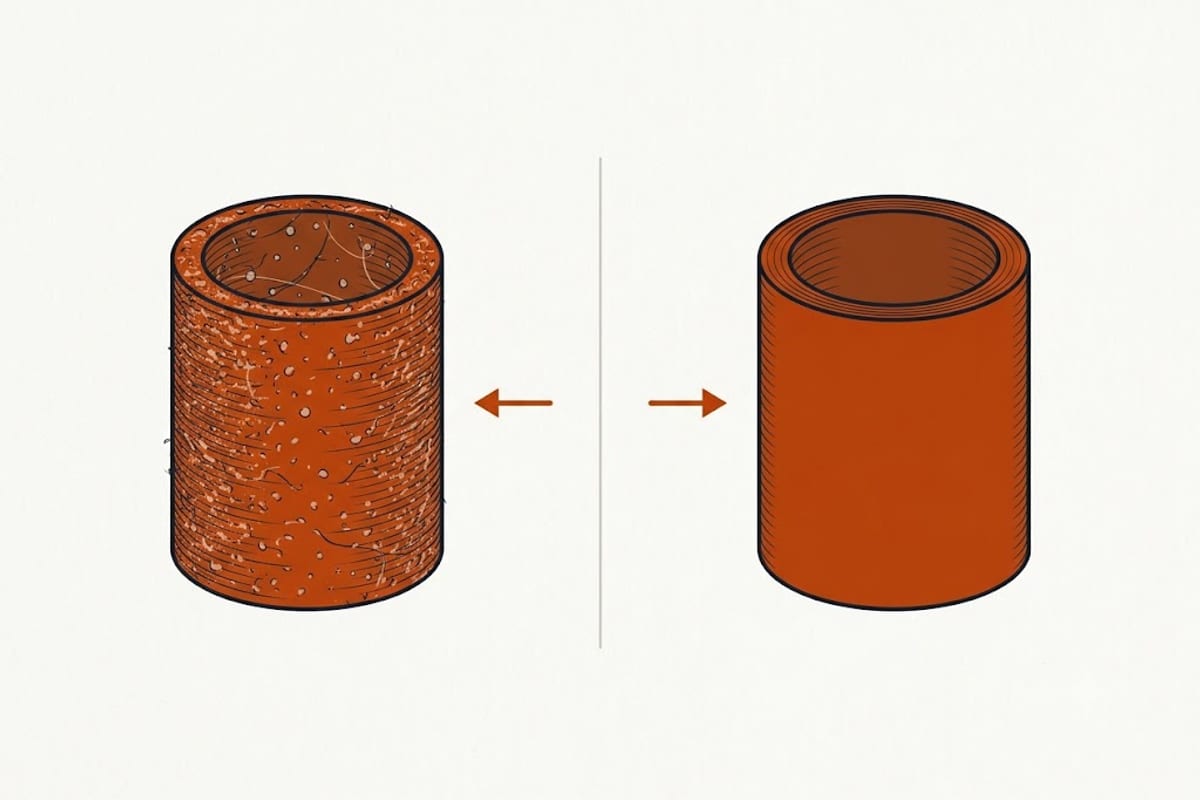
The visible signs follow from the same cause. Steam escaping through the extrudate leaves voids, and voids give you a foamed, rough surface, weak layer bonding and a filament diameter that wanders.
Temperatures by material
The number is set by the plastic's glass transition temperature — the point at which it softens. Dry below it and you drive off water. Reach it and the spool deforms, welds to itself, and becomes unusable.
| Material | Temperature | Time |
|---|---|---|
| PLA | 45–55 °C | 4–6 h |
| PETG | 65 °C | 6 h |
| ABS / ASA | 70–80 °C | 4–6 h |
| Nylon (PA) | 70–80 °C | 12 h+ |
| TPU | 50–55 °C | 6–8 h |
PLA has the lowest ceiling because its glass transition sits around 60 °C — barely above its own drying temperature. That narrow margin is why PLA is the material people most often ruin while trying to fix it, and why "just turn it up to be safe" is exactly the wrong instinct here.
Nylon is at the other extreme: it absorbs more water than anything else in common use, and a spool left out overnight can need a full twelve hours to recover.
Why not the kitchen oven
Because a domestic oven does not hold a temperature — it cycles around one. A thermostat set to 50 °C typically overshoots on the way up, and PLA does not need much overshoot to start softening. Spools come out oval, or fused into a single block that no longer unwinds.
The gap between "dry PLA" and "ruined PLA" is roughly ten degrees, which is narrower than the swing of most household ovens.
What works, in order of how well:
- A purpose-built filament dryer. Holds temperature, and most let you print straight from the chamber.
- A food dehydrator. The same job for less money — flat, stable, low-temperature heat is exactly what a dehydrator is built to do.
- The heated bed with a box over it, if you have nothing else. Crude, uneven, but better than printing wet.
Drying is a repair; storage is the fix
A dried spool starts reabsorbing moisture the moment it leaves the chamber. In a humid room, PETG or nylon can be measurably wet again within a day or two.
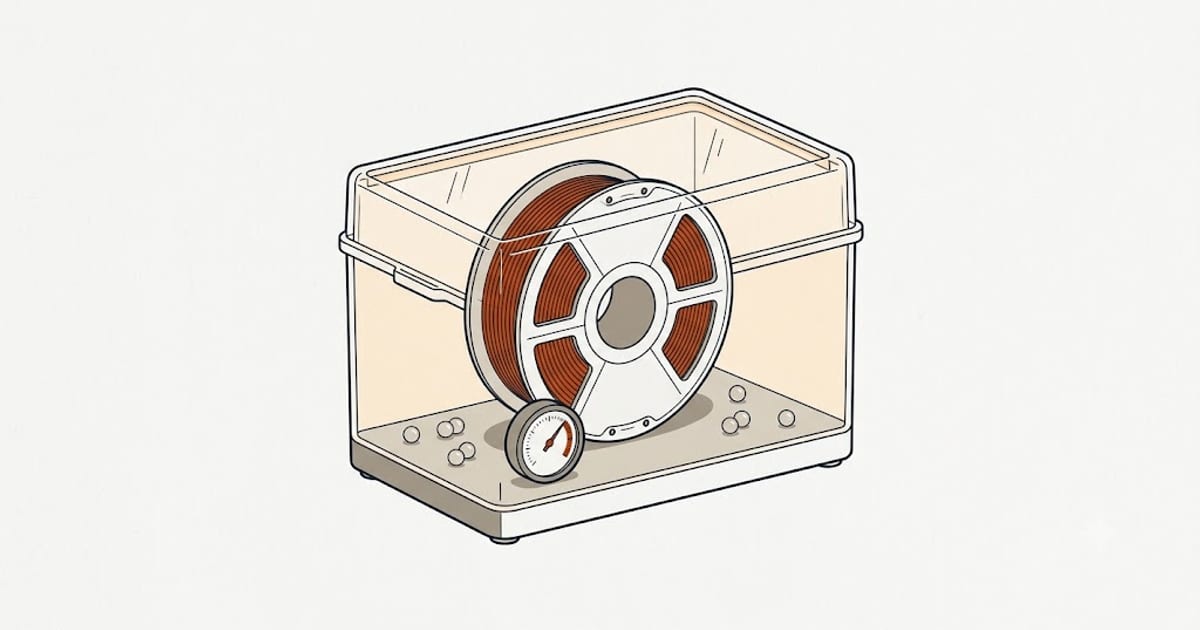
Storage that actually works is a sealed container plus indicating silica gel — the kind that changes color when saturated, so you can see when to recharge it rather than guess. Target below roughly 20% relative humidity inside the box, and put a cheap hygrometer in there so the number is visible rather than hypothetical.
Desiccant that has never changed color is either brand new or not working. Both are worth knowing.
Which filaments actually need this
Not equally. Ranked by how fast they take on water:
- Nylon — hours, not days. Effectively must be printed from a dry box.
- TPU — fast, and the symptoms are severe.
- PETG — fast enough that every major brand publishes a schedule. See PETG print settings.
- ABS/ASA — moderate.
- PLA — slowest, but not immune. A spool open on a shelf for a month in a humid climate will print visibly worse. See PLA print temperature for what a good PLA print should look like.
FAQ
How do I know if my filament is wet?
Listen for popping or crackling at the nozzle during extrusion, and look for steam. Those are specific to moisture. Stringing and weak layers can have other causes, but combined with the sound they confirm it.
Can I dry filament in a kitchen oven?
It is the most common way people ruin spools. Household ovens cycle around the set point rather than holding it, and PLA's glass transition is only about ten degrees above its drying temperature. Use a dehydrator or a filament dryer.
How long does dried filament stay dry?
In open air, days for PETG and nylon, weeks for PLA — faster in humid climates. Sealed with active desiccant, indefinitely.
Does drying filament damage it?
Not at the published temperatures. Above them, the spool softens and can deform or fuse. The risk is entirely about exceeding the temperature, not about drying itself.
Do I need to dry brand new filament?
Sometimes. Vacuum-sealed spools with intact desiccant are usually fine, but the seal may have been compromised in shipping or storage, and some brands ship without desiccant at all. If a new spool pops at the nozzle, dry it.