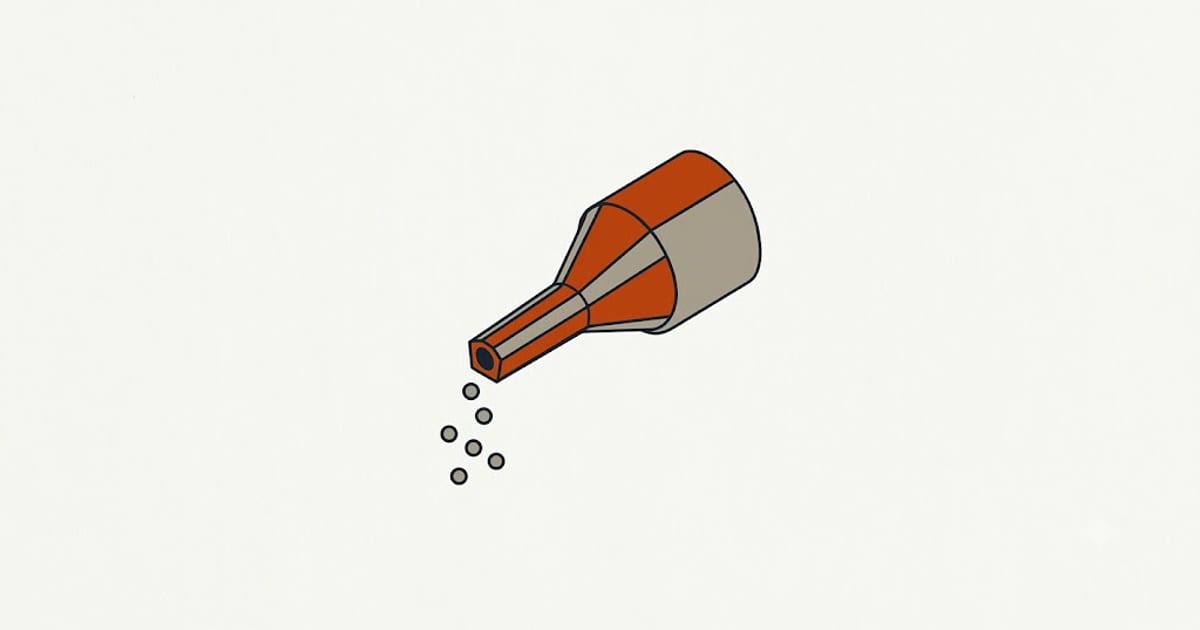
Filament is hygroscopic — it absorbs water from the air. At printing temperature that water flashes to steam inside the nozzle and blows the extrusion apart as it leaves.
Everything below is a symptom of that one mechanism.
The audible sign
Popping, crackling or hissing at the nozzle. This is unambiguous. Dry filament extrudes silently; wet filament pops as steam escapes.
Listen with the printer's own fans as the only other noise, at the start of a print. If you can hear it, the filament is wet enough to matter.
The visible signs
Rough or fuzzy surface, where extrusions look torn rather than smooth.
Bubbles or blisters on the extruded strand, visible if you extrude a length into air and look at it.
Stringing that appeared suddenly on a profile that used to be clean. Moisture is one of the few things that changes stringing without any setting changing.
Inconsistent extrusion width, showing as thin patches and blobs along a line.
Weak, brittle parts that snap between layers, because steam disrupted the interface where the weld should have formed.
The test that takes two minutes
Heat the nozzle to printing temperature, retract nothing, and extrude a slow continuous strand into air.
Dry filament produces a smooth, glossy, consistent strand that curls gently. Wet filament produces a rough strand with visible bubbles, accompanied by popping, and it often comes out wider than the nozzle because steam expanded it.
Do this with a suspect spool and with a freshly opened one for comparison. The difference is obvious once seen.
How fast it happens, by material
PLA absorbs slowly and tolerates a fair amount. Weeks to months in ordinary indoor air before it matters.
PETG absorbs faster and shows it clearly. Days to weeks in a humid room.
Nylon is extreme — hours of exposure produce visible effects, and it is generally printed straight from a dryer.
TPU absorbs quickly and prints badly when wet, and the symptoms are easy to mistake for the material simply being difficult.
ABS and ASA sit between PLA and PETG.
Ambient humidity dominates all of this. A spool left out in a dry winter room may be fine for months; the same spool in a humid summer is not.
Drying
Temperature and time by material, roughly: PLA around 45 to 55°C for 4 to 6 hours; PETG around 60 to 65°C for 4 to 6; nylon 70 to 80°C for 8 to 12.
Do not exceed the glass transition temperature of the material, or the filament softens and the spool welds itself into a solid block. This is the one way drying can destroy a spool, and PLA is the material most at risk because its glass transition is low.
A dedicated filament dryer holds temperature accurately and is the safe option. A food dehydrator with a reliable thermostat works. An oven is risky because domestic ovens overshoot substantially at low set points.
Storage that prevents it
A sealed container with fresh desiccant is the whole answer. Vacuum bags work, dry boxes work, and an airtight tub with silica gel works.
Desiccant is consumable and it saturates. Indicating silica gel changes colour when spent and can be regenerated by heating; non-indicating desiccant gives no warning and is often the reason a "dry box" is not dry.
Store the hygrometer with the filament rather than trusting the container to be sealed. Below about 20% relative humidity inside the box is the target, and anything above 30% means the seal or the desiccant has failed.
Drying a spool does not undo everything
Moisture that has been absorbed and driven off leaves the filament usable, and prolonged wet storage can still degrade some materials chemically. PLA in particular hydrolyses slowly, and a spool that spent a humid year on a shelf may print acceptably after drying and still be more brittle than it was new.
Where a dried spool still produces weak parts and the extrusion test looks clean, the material rather than the moisture is the problem, and the honest answer is a new spool.
Printing straight from a dryer
For the materials that absorb fastest — nylon, TPU, and PETG in a humid climate — drying before a print is not enough, because the spool reabsorbs during the print itself. A long print can undo a full drying cycle.
The practical answer is to feed from the dryer, with the filament running out through a port while the box stays warm. This is standard practice for nylon and increasingly common for everything else in humid regions.