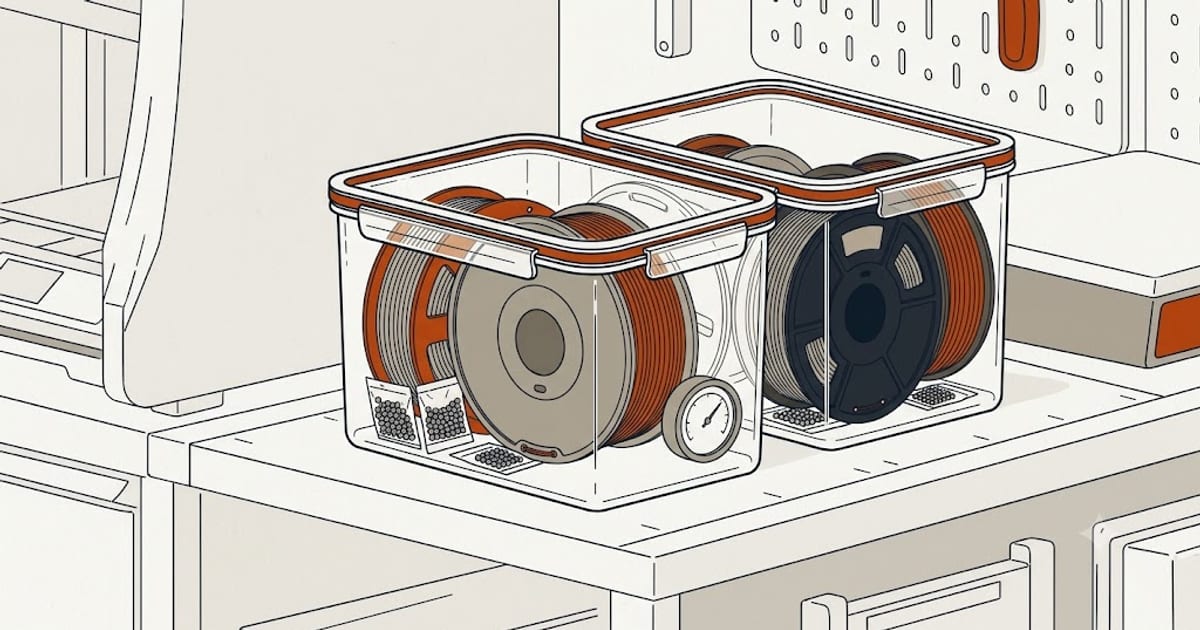
Drying a spool fixes today's problem. Storage decides whether you have it again next month.
Target below 20% relative humidity
Two things get you there and you need both.
An airtight container. Sealed food containers, dry boxes designed for filament, or vacuum bags. A cardboard box is not a container; nor is the bag the spool arrived in once opened.
Indicating silica gel. The kind that changes colour as it saturates. Non-indicating desiccant gives you no way to know whether it is working or exhausted, and exhausted desiccant sitting in a sealed box does nothing while looking exactly like the working kind.
Add a cheap hygrometer inside. Under $10, and it turns the whole question from guesswork into a number you glance at.
Desiccant that has never changed colour is either brand new or dead. Both are worth finding out about.
Recharge the desiccant
Silica gel is reusable. Heat it and the water drives off.
Roughly 120 °C for two to three hours dries most types, but check what yours specifies — some beads have coatings that will not tolerate that. Colour returning to the dry state is the signal.
Two batches in rotation is convenient: one in the box, one being recharged.
Which materials need what
Ranked by how fast they take on water:
| Material | Absorption | Storage |
|---|---|---|
| Nylon (PA) | very fast | dry box, print from it |
| TPU | fast | sealed with desiccant |
| PETG | fast | sealed with desiccant |
| ABS / ASA | moderate | sealed |
| PLA | slow | sealed, but forgiving |
Nylon is the outlier. It can absorb enough moisture in a few hours of open air to print badly, which is why nylon users print directly from a heated dry box rather than storing and hoping.
PLA is the most forgiving and not immune — a spool left open on a shelf for a month in a humid climate prints visibly worse.
Print from the box
For nylon and TPU, the practical answer is a heated dry box with a filament port: the spool stays in a controlled environment while feeding the printer.
For PETG in a humid climate, worth considering. For PLA, generally unnecessary.
Ordinary things that help
Keep spools off concrete floors. Concrete wicks moisture and a garage floor is a humid place.
Reseal immediately after use. The spool that lives on the printer between prints is the one that fails.
Keep the desiccant that came with the spool. Manufacturers include a packet; it goes in your container, not the bin.
Label the date opened. Six months later you will not remember, and the tell for wet filament — the popping sound at the nozzle — is described in how to dry filament.
FAQ
How should filament be stored?
In an airtight container with indicating silica gel, targeting below 20% relative humidity. Add a cheap hygrometer so the number is visible.
How long does filament stay good in storage?
Sealed with active desiccant, indefinitely. In open air, days for nylon and PETG, weeks to months for PLA.
Can silica gel be reused?
Yes. Heat it to about 120 °C for two to three hours, or as the manufacturer specifies. Indicating beads return to their dry colour.
Do I need a dry box for PLA?
Usually not. Sealed with desiccant is enough for PLA. Nylon and TPU genuinely benefit from printing directly from a dry box.
Is the bag the filament came in good enough?
Only while sealed with its desiccant. Once opened, it is not airtight and the desiccant will exhaust.