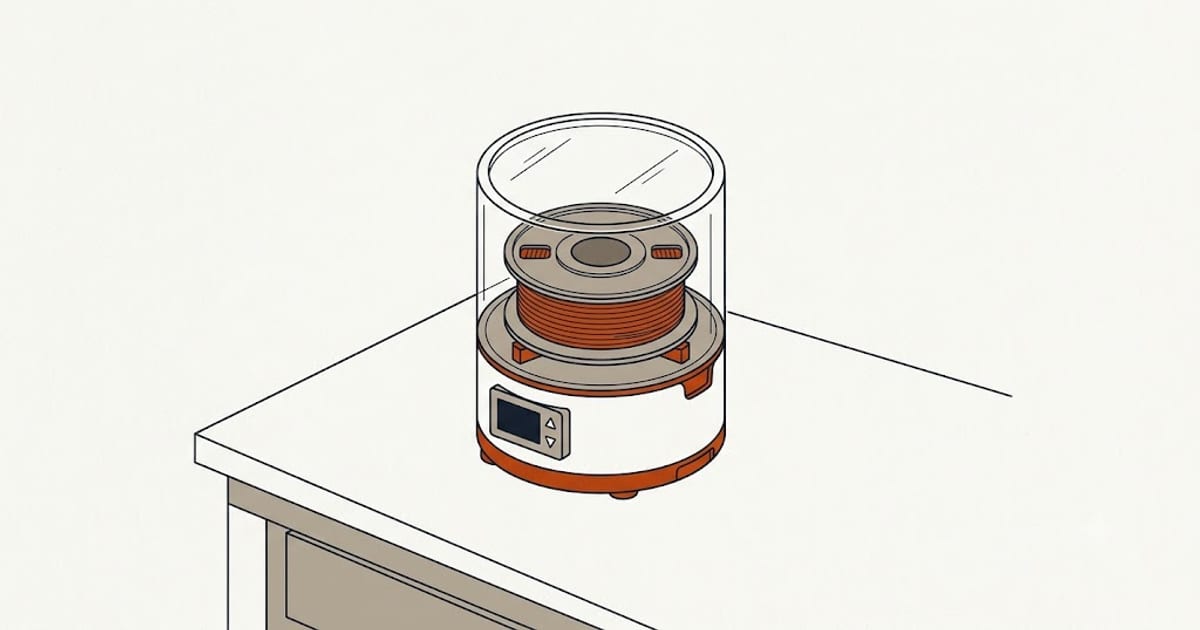
Both do the same thing: hold a spool at a controlled low temperature so absorbed water leaves without softening the plastic.
The difference is what happens around that.
Purpose-built filament dryer
Filament port. The spool feeds the printer while staying in the chamber. For nylon and TPU this is not a convenience, it is the only way to print them reliably in a humid room — they reabsorb moisture faster than a print takes.
Presets by material. Reduces the chance of setting PLA to a nylon temperature, which is how spools get ruined.
Sized for spools. No stacking trays to work around.
Costs more, and usually holds one or two spools.
Food dehydrator
Cheaper, often substantially.
Larger capacity. Remove the trays and several spools fit at once — useful after a humid spell, or for a spool collection that has been sitting.
Good temperature control. Dehydrators exist to hold low stable temperatures for hours; that is precisely the job.
No filament port, though people cut one. That voids any warranty and is a decision to make deliberately.
Check the low end. Some dehydrators do not go below about 40 °C or have coarse steps. PLA needs 45–55 °C, and a unit whose lowest setting is 60 °C is not usable for PLA at all.
Which to buy
Dehydrator if you print mostly PLA and PETG, dry occasionally, and want capacity for the money. This covers most people.
Filament dryer if you print nylon or TPU, or live somewhere humid enough that PETG needs drying regularly. The filament port is the whole reason and it is worth the premium when you need it.
Both is not unreasonable at scale — a dehydrator for bulk drying, a small dryer on the printer for the spool in use.
Not the oven
Repeating it because it is where spools die.
A domestic oven does not hold a temperature — it cycles around one, overshooting on the way up. PLA's glass transition is around 60 °C and its drying temperature is 45–55 °C. That margin is narrower than the swing of most household ovens.
Spools come out oval, or fused into a block that will not unwind. Temperatures by material are in how to dry filament.
Neither replaces storage
A spool dried and returned to open air starts reabsorbing immediately — days for PETG and nylon, weeks for PLA.
Drying is the repair. Storage is the fix, and it is a sealed box with indicating desiccant, covered in how to store filament.
A dryer used as storage — spool left in a switched-off chamber — is just a box that is not airtight.
How long, and how to know it worked
Time depends on the material and on how wet the spool is, not on the appliance. The schedules in how to dry filament are starting points — a badly saturated nylon spool can need considerably longer than the published twelve hours.
Two ways to confirm rather than assume:
Weigh the spool before and after on a kitchen scale. Absorbed water has mass, and a saturated spool can shed several grams. When the weight stops falling between sessions, it is dry.
Listen at the nozzle. The popping and crackling of steam escaping through molten plastic is the definitive symptom, and its absence is the definitive all-clear. It costs one short test print.
A hygrometer inside the chamber is less useful than it sounds during drying — it reads the air, which is being actively dried, rather than the spool.
Ventilation matters more than people expect
Both appliance types need somewhere for the driven-off moisture to go. A sealed chamber with no vent reaches equilibrium: the air saturates and the spool stops losing water while the display still reads the target temperature.
Purpose-built dryers have vents for this reason. Dehydrators are open by design, which is one of the quiet advantages of using one.
If you have modified a chamber to seal it — for printing from it — remember that the same modification works against you during the drying phase.
FAQ
Can I use a food dehydrator to dry filament?
Yes, and it is the cheaper option with more capacity. Check its lowest temperature setting reaches 45–55 °C for PLA.
Is a filament dryer worth it?
If you print nylon or TPU, yes — the filament port lets you print from the chamber, which those materials need. For PLA and PETG a dehydrator does the same job.
Can I dry filament in the oven?
Not safely. Ovens cycle around the set point, and PLA's softening point is only about ten degrees above its drying temperature.
How many spools can I dry at once?
A dehydrator with trays removed usually takes several; most purpose-built dryers hold one or two.
Does a dryer work as storage?
No. Switched off it is not airtight. Use a sealed container with indicating desiccant.