
Every slicer reports estimated filament use in grams and in metres before the print starts. It is accurate for the part itself, and it is not the whole consumption.
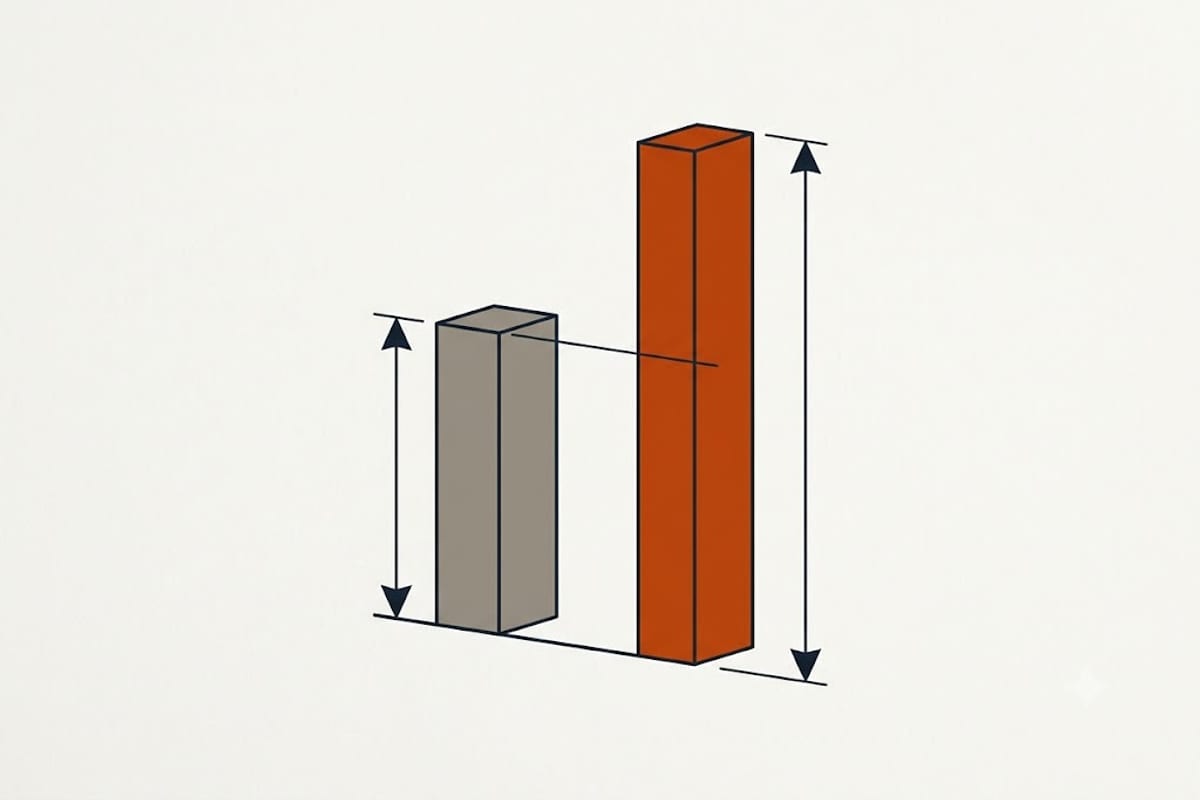
What a spool actually holds
A 1 kg spool of 1.75 mm PLA contains roughly 330 metres of filament. The arithmetic: cross-sectional area is about 2.4 mm², PLA density is about 1.24 g/cm³, giving roughly 3 grams per metre.
For 2.85 mm filament the same kilogram is about 125 metres, because the cross-section is nearly two and a half times larger.
Density changes the figure by material. PETG at about 1.27 g/cm³ is close to PLA. ABS at about 1.04 is lighter, so a kilogram goes further in length. Filled filaments — wood, carbon, metal — are heavier and a kilogram goes a shorter distance.
Converting between grams and metres
grams per metre (1.75 mm) ≈ 2.4 mm² × density in g/cm³ ÷ 1000 × 1000
                          ≈ 3.0 g/m for PLA
So a print the slicer reports as 60 grams uses about 20 metres, and a 1 kg spool yields about sixteen such prints — in theory.
What the estimate leaves out
The priming line or skirt at the start of every print. Small, and it happens every time.
Purge and tower on multi-material prints, which can exceed the part itself on a four-colour model. This is the largest single omission where it applies.
Failed prints. A print that fails at 80% has consumed 80% of its material. Over a year this is a meaningful fraction of total consumption, and it is the item people forget when costing.
The unusable tail on the spool — the last few metres that will not feed reliably, plus whatever is clamped in the spool hole.
Nominal against actual spool weight. Some spools contain slightly less than the stated weight; the figure is a nominal.
A working allowance is that real consumption runs perhaps 10 to 20% above the sum of slicer estimates, more if failures are frequent or multi-material is common.
Reducing what a part uses
Infill percentage is the obvious lever and it has diminishing returns. Going from 20% to 10% saves material and costs stiffness; going from 20% to 40% adds a great deal of material for a modest strength gain, because most of a printed part's stiffness lives in the walls.
Wall count is the better lever in both directions. Adding a perimeter buys more strength per gram than raising infill.
Orientation changes support requirements, and support is pure waste. Rotating a part to eliminate supports often saves more material than any infill change.
Infill pattern matters less than people expect for material use — gyroid, grid and cubic at the same percentage use similar amounts, and differ in print time and in how they behave under load.
Tracking it
Weighing the spool before and after a print is the only exact method, and a kitchen scale is accurate enough. Subtract the empty spool weight, which is printed on many spools and otherwise has to be measured once.
Doing this for a handful of prints calibrates the gap between the slicer's estimate and reality on your machine, and after that the estimate plus a fixed percentage is close enough for costing.
Costing a print properly
Material is usually the smaller half of what a print costs. The other components are electricity, machine wear and the time spent preparing and finishing.
Electricity is modest — a typical desktop printer draws in the region of 50 to 150 watts averaged over a print, which over ten hours is a small figure in most markets. Machine wear is real but hard to allocate: nozzles, belts, bed surfaces and hotend components all have finite lives measured in print hours.
For anyone selling prints, the honest formula is material at the real consumption figure, plus a machine-hour rate that recovers wear and electricity, plus labour for setup and post-processing. Pricing on material alone is how people discover a year later that the printer paid for nothing.
Storage affects yield as well
A spool that has absorbed moisture prints worse and fails more often, and failed prints are consumed material. Keeping filament dry is a cost control as much as a quality one, and it matters most for the materials that are expensive to begin with.